The function is new and demand for digital solutions is growing across operational, clinical and corporate services. My first task is to establish a clear applications development approach and lead the delivery of one realistic digital application or improvement that demonstrates early value while creating safe, sustainable foundations for the future.

Jonathon Page
First 90 days: Establishing a trusted digital applications function
0 to 90 in 10 minutes
Success Starts Here
The Guiding Principle
Core Requirement
Establish a trusted digital applications development function
This guiding principle should be expected to stand until we are the de facto trusted digital applications guardians for the Trust. It is the driving force behind all other decisions we will make as a team.
What Does It Take To Be Trusted?
Building Trust
Core Pillars
We have to be seen to be believed
Building Trust - Being Seen
Networking
Build relationships early
Product
Release a product to establish credibility
We've got to start somewhere
Week 1: Getting Started
We've got to start somewhere
Week 1: Getting Started
-
Meet the Team
Discover the capabilities of the team: what skills do we have? What skills are we missing? Where are our strengths and weaknesses?
-
Meet the Management
-
Basic Alignment
What are your goals? What have we already committed to? Do you have early projects ready to pursue, or fixed ideas about the direction of the team?
-
Critical Information
Is there anything urgent or safety-related I should know from day one? Who are my key contacts for cyber security, infrastructure, and governance?
-
-
Meet Clinical and Operational Leads
Reach out and start booking time with the people closest to patient care and day-to-day operations — building these relationships early is where real project discovery begins.
-
Open the Door
Encourage people to reach out and chat. Advertise who I am and what I'm here to do, and be proactive in the search — anyone who wants to talk is welcome.
-
Start Looking, Not Just Listening
A first, light look at what applications and workarounds already exist — enough to start the deeper landscape review properly over the following weeks.
Strong roots for a prosperous future
Preparing for the Future
- Create an environment that supports best practice
- Version control systems are non-negotiable
- Coding standards are not optional, and will be created collaboratively by the team
- Information governance concerns have to be addressed proactively
- Risk assessments must be carried out for any systems we build
Trust with the team, built before the first line of code
Preparing for the Future
-
An Environment That Supports Best Practice
The right tooling and workflow from day one — a team working around missing infrastructure will quietly normalise cutting corners.
-
Version Control Is Non-Negotiable
Every change tracked, every release reproducible. This isn't a preference — it's the baseline that makes everything else in this section possible.
-
Coding Standards, Set Together
Created collaboratively by the team, not handed down — standards people helped write are standards people actually follow.
-
Peer Review as Habit
A second pair of eyes on every change, before it moves further — catching problems while they're still cheap to fix, and spreading knowledge across the team.
-
Information Governance, Addressed Early
Considered at design stage for every project, not raised as a question once something is already built.
-
Risk Assessments, Every Time
Carried out for any system we build or change, however small it looks — consistency here is what makes the assessment meaningful.
Trust starts with honest understanding
Understanding the Landscape
-
Audit What Exists
Map the current application estate: what's supported, what's end-of-life, what's shadow IT holding a service together quietly. You can't prioritise what you can't see.
-
Go Where the Work Happens
Sit with control room staff, crews, and corporate teams doing the work day to day. The best backlog comes from watching people work around a problem, not from a workshop.
-
Listen to What Already Complains
Incident reports, complaints, and audit findings often already contain the digital pain points — I'd mine what exists before asking people to repeat themselves.
-
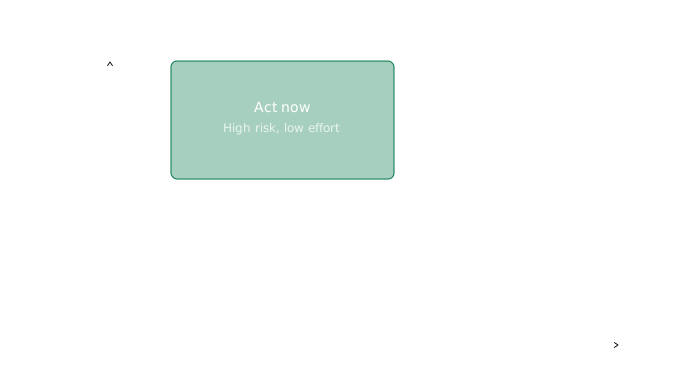
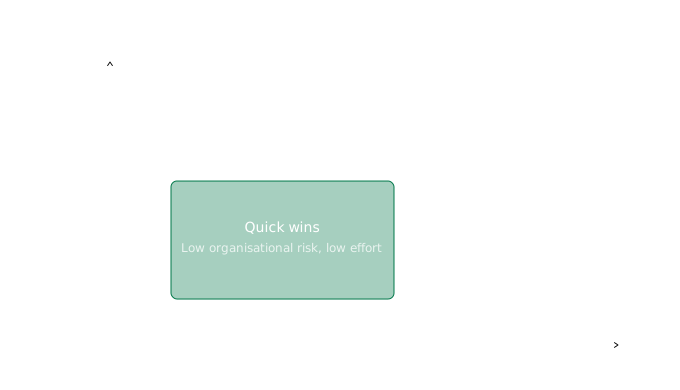
Prioritise on Two Axes
Safety and risk on one axis, effort and deliverability on the other. This gives an honest, defensible shortlist rather than whoever asked most recently or most loudly.
First wins build foundational credibility
The Project Search
First wins build foundational credibility
The Project Search
Trust with the people who'll actually use it
The First Project
Illustrative example
Digitising a paper-based vehicle or equipment safety checklist
I don't yet know the Trust's actual backlog, so this is deliberately an example of the kind of first project I'd look for — not a prediction of what I'd find. What matters is the pattern it represents.
The pattern matters more than the example
Why This Kind of Project
-
Low Clinical Risk
A checklist or reporting improvement carries little risk of direct patient harm if something goes wrong early on — a safe place to learn as a new function.
-
High Visibility
Crews and managers feel the difference immediately: less paper, faster completion, better data. A clear before-and-after story to point to.
-
Genuinely Deliverable
Scoped to weeks, not months. The first release from a new function should be small enough to actually ship.
-
A Foundation, Not a One-Off
The same pattern — replacing paper or manual steps with a simple, well-tested digital equivalent — is repeatable across operational and corporate services.
Trust in my own judgement
Build, Buy, Configure, Automate, Integrate
-
Buy or Configure First
If it's a problem already solved elsewhere in the NHS, I default to buying or configuring — there's no credit in reinventing a solved problem.
-
Automate or Integrate
Where the gap is plumbing between existing systems — data moving manually that shouldn't be — automation or integration is usually faster and lower-risk than new software.
-
Build Only With a Reason
I'd only recommend building where there's a genuine, specific gap, and where we can commit to owning and supporting it long-term. Building without ownership is how technical debt starts.
-
Applied to the Example
For a checklist-style project, I'd expect to configure an existing form/workflow platform rather than build custom software — quick to deploy, easy to support, low long-term cost.
Trust with the team, and everyone after us
How We Work
-
Test Before It's Trusted
Automated testing where practical, and real user acceptance testing with the clinical or operational staff who'll actually use it — not just the team who built it.
-
Release Safely, Not Silently
Staged rollout to a small group first, a clear rollback plan, and visible communication about what's changing and when.
-
Documentation as a Deliverable
Not an afterthought — if it isn't documented, it isn't finished. This protects the team and the Trust when I'm not in the room.
Trust with the people who have to say yes
Governance as a Partner, Not a Gate
-
Bring Them In Early
Information governance and cyber security involved from the first design conversation, not asked to approve a finished product.
-
Procurement and Finance as Allies
Early, honest conversations about cost and route to market avoid late surprises and build a working relationship I'll need again on the next project.
-
Suppliers Held to the Same Standard
Clear expectations on support, security, and data handling — trust extends to anyone whose code touches our systems.
-
NHS Wales, Not WAST Alone
Early contact with Digital Health and Care Wales and peers in other health boards — to avoid duplicating work that already exists elsewhere in Wales.
Trust with the public we ultimately serve
Non-Negotiables
-
Safety First, Always
Every system considered for its potential to affect patient or staff safety, with a clinical safety assessment where relevant.
-
Accessible by Design
Built to accessibility standards from the start, not retrofitted — this affects staff and members of the public alike.
-
Welsh Language, Built In
Meeting Welsh Language Standards and the Active Offer as a design requirement, not an afterthought bolted on before release.
-
Data Protection and Cyber Security
Privacy and security considered at design stage, aligned to NHS Wales standards — protecting patient and staff data is foundational, not a checkbox.
-
Business Continuity
Every system needs a fallback plan — paper or manual process included — for when it's unavailable. Digital should never become a single point of failure for care.
Trust doesn't end at go-live
From Built to Believed
-
Train and Champion
Practical training and local champions on the ground — people trust colleagues who show them something works more than they trust an email announcement.
-
Roll Out in Stages
A phased rollout, learning from the first group before wider release, with a clear route for feedback to reach the team quickly.
-
Measure the Benefit, Not Just the Launch
Time saved, errors reduced, or experience improved — tracked against a baseline, so "delivered" and "delivering value" aren't treated as the same thing.
-
Support Doesn't Stop at Handover
Every product has a named owner and support path after launch — I won't be moving to the next project and leaving this one to fend for itself.
Naming the risks is part of being trusted
Risks and How I'd Hold Them
-
A Safety Incident Linked to a Digital System
Mitigated through clinical safety assessment, staged rollout, and always keeping a manual fallback available.
-
Poor Adoption After Launch
Mitigated by involving users from day one, choosing genuinely useful first projects, and having champions on the ground rather than relying on a single announcement.
-
Scope Creep on the First Project
Mitigated by a tightly agreed scope up front and the discipline to say "that's a good idea for phase two," protecting the credibility of an early win.
-
An Information Governance or Security Gap
Mitigated by involving IG and cyber security from the design stage, not as a late-stage checkpoint.
Understanding Ourselves and Our Future
Measuring Success At 3 Months
- Foundations / Fundamentals
- Clear Project Goal
- Beginnings of a Project Pipeline
- Commitment
Delivering Early Value
Measuring Success At 6 Months
- Delivery of First Project
- Solid Prototypes for Development Standards
- Positive Relationships with Other Departments
Becoming a Trusted Partner
Measuring Success At 12 Months
- Established, prioritised project pipeline
- First project delivering measurable benefit
- Team recognised and trusted across operational, clinical, and corporate services
- Standards, testing, and release process fully embedded
The Future
The Cornerstones of Trust
- Continue to deliver valuable supporting services across the Trust
- Live up to the promises we've made, communicate openly
- Deliver on our agreements
- Support and invest in our team